October 09, 2026



Your first weekend congress begins before the first move: with a form on a club noticeboard, a decision about which section to enter, and a Saturday morning spent walking into a school hall, finding your name on a pairing sheet, and sitting down opposite someone you have never met. It is slightly odd, quietly exciting, and far friendlier than newcomers expect. Nothing about it is difficult. It is just unfamiliar.
Most players start locally. Club noticeboards, county association websites and the ECF calendar list events within an hour's drive: one-day rapidplays, which are five or six short games, and weekend congresses, usually five rounds spread across Saturday and Sunday. A rapidplay is the gentler introduction — you learn the routine, play six games, and are home for tea.
Sections are where beginners get nervous. A congress is split into an Open and several banded sections, usually divided by rating, with the lowest often called the Minor or Foundation. Enter a section where you will be roughly mid-pack, not the strongest and not the weakest. If you have never played a rated game, say so on the form and let the organiser place you.
As a rough guide, if you are rated around 1100, an Under-1400 or Minor section will give you competitive games; if you are nearer 1500, look for an Under-1700 or Intermediate section. The goal is not to win the section in your first event. It is to play five or six proper games, learn how a tournament runs, and finish wanting to come back.
Enter early. Popular events fill up and run reserve lists, and some organisers simply will not take entries after the closing date. If you need to miss a round, request a half-point bye on the entry form — most events grant them in the early rounds only.
The form is short, but it asks for things you may not have to hand:
Most UK congresses expect you to be an ECF member, or they add a supplement to cover the game fee. Check that before you post the form. If you are unsure whether you are a member, look up your record on the ECF website or ask your club secretary. It is a five-minute job that saves an awkward conversation on the morning.
You need less than you think, but a few items turn a stressful morning into a comfortable one. Pack the night before and keep it simple.
Leave the chess books and opening files at home. Between rounds you need rest, food and a short walk more than one more line of theory.
If in doubt, bring it in a bag you can leave at the side of the hall. The board is the only place that needs to be tidy.
Arrive with time to spare. Aim for thirty minutes before the first round. You need to find the venue, the toilets, the pairing list, and your board. Pairings usually go up fifteen to thirty minutes before play. Find your name, note the board number, and check your opponent's name and colour. If you are White, set up the board; if you are Black, wait and then set your clock. Many events have a short welcome and announcements — listen for the start time, mobile phone policy, and how to find the arbiter.
When the arbiter says start, shake hands and play. If you are nervous, remember that your opponent is probably nervous too. Nobody is watching you as closely as you imagine. The first few moves will feel normal once the clock is ticking.
The ECF spent decades using three-digit grades, then moved to four-digit ratings on the same scale as international Elo ratings. Either way, the number is a rough measure of strength, not a verdict on you. If you are unrated, your first few games establish a starting point, and your rating can swing around while it settles. A heavy defeat costs you far less than it feels like at the time.
Ratings are a guide, not a judge. If yours is lower than your opponent's, you are not expected to lose; you are simply the underdog on paper. Upsets happen every weekend, especially in rapidplay. One loss to a much stronger player may hardly move your rating at all. Focus on playing the position, not the number beside your name.
Standard-play congresses commonly run something like 90 minutes for the first 40 moves, then 30 minutes to finish the game, with a 30-second increment added for each move. Rapidplays are shorter — often 20 or 25 minutes plus a 10-second increment. The exact control is on the entry form, and it is worth reading properly.
Set your clock before the round starts and agree it with your opponent: check the display, confirm the increment, and make sure you know which button is yours. Press with the same hand you used to make the move. In non-increment games, many events let you stop writing your moves once you drop below five minutes; ask the arbiter if you are unsure.
If you have never used a digital clock, ask a clubmate to show you one before the event. Learn how to add time, how to pause, and how to reset. That small familiarity removes a surprising amount of first-round panic.
Do not treat the clock as an afterthought. First-timers lose more games to time than to tactics.
Chess has more manners than rules, and the manners matter.
Tournament days are long. Between rounds, step away from the board. Eat something, drink water, and get some fresh air. Resist the urge to replay every mistake with anyone who will listen. A short walk or a few minutes with a book will reset your head better than an autopsy. If you have a long break, check the next pairings
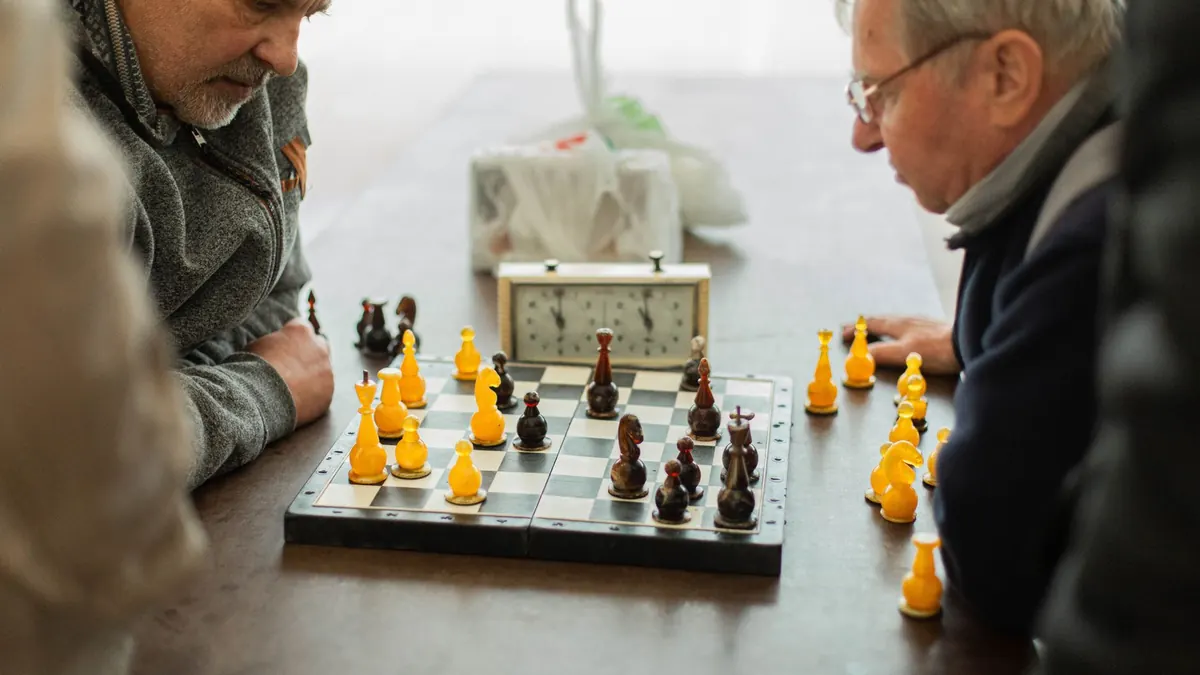
Photo: Елена Марценюк / Pexels
Chess strategy and tactics for your desk.
Copyright © 2026 Rook Desk. All rights reserved. Rook Desk.